


Advertisements
Need fast cash but fear falling into the trap of abusive interest rates from major banks? Many people lose sleep trying to balance their budget, unaware that the Navy Federal personal loan might be the fairest and cheapest option on the market.
Here you will discover exactly what banks don’t tell you: high limits, same-day disbursement, and legally capped interest rates. Understand if the Navy Federal personal loan is really worth it for your wallet and see how to avoid hidden fees that drain your money.
Advertisements
But beware: there are approval rules and contractual details that almost no one notices before applying. Read on to check all the secrets of the Navy Federal personal loan and find out if you are already eligible for this line of credit today.
Who is eligible to apply for a Navy Federal personal loan?

To access any personal loan line, the initial requirement is that you must be an active member of the institution.
Because it is focused on the defense sector, admission rules target a well-defined audience.
The following groups of people can join:
- Active-duty military service members of any U.S. armed forces branch, reservists, and National Guard members.
- War veterans and lifetime retired military personnel.
- Students in military officer training programs, cadets, and midshipmen.
- Immediate family members such as spouses, parents, children, grandparents, siblings, and grandchildren of members.
- Individuals who reside in the same household as a registered member.
- Department of Defense civilian personnel and contractors working at federal bases.
To join the credit union, the process requires proof of identity, a tax registration number, and an initial deposit of $5.00 into a savings account.
Advertisements
This nominal amount serves as your membership share in the organization.
All available types of Navy Federal personal loans
The institution offers tailored alternatives for anyone needing financial resources at different stages of life. Knowing each product helps you choose the right option without paying unnecessary interest.
1. Personal expense and emergency loans
This is the most popular unsecured option for covering general day-to-day expenses. You can use the funds for family vacations, unexpected medical bills, simple renovations, or moving costs.
The minimum amount for borrowing starts at just $250.00, going up to $50,000.00 for individual applications. If you need a higher limit, it is possible to reach up to $150,000.00 by adding a qualified co-applicant to the contract.
2. Debt consolidation into a single installment
If you have overdue credit card balances or expensive loans, this line combines everything into a single monthly payment. The fixed interest rate is usually much lower than revolving credit card rates.
Limits for consolidating debt range from $250.00 to $50,000.00. Keep in mind that the institution does not pay off debts directly to other creditors. The total amount goes straight into your account, and you handle paying off your existing balances yourself.
3. Home improvement financing without using home equity
Renovating a home can be expensive and involve a lot of real estate bureaucracy. The institution created a specific line for renovations that does not require putting your property up as collateral.
You can request between $250.00 and $150,000.00, with repayment terms up to 180 months. Since there is no mortgage lien, you save time and money on legal fees and property appraisal reports.
4. Savings- or Certificate-secured loans
Anyone with money saved at the credit union can use that balance as collateral for the transaction. This allows you to secure immediate credit at the lowest market rates.
The limit can reach up to 100% of the amount you keep deposited. The main advantage is that there is no strict review of your credit history, and your savings continue earning regular dividends while you make monthly payments.
5. Military career transition and starter loans
Designed exclusively for graduating cadets and newly commissioned officers from military academies, this line offers financial support for purchasing work gear, uniforms, and initial professional relocation costs.
The rates charged are heavily subsidized and start at very low levels. The product also features an extended deferred payment period, giving service members breathing room until they begin receiving their regular paychecks.
What is not allowed to be financed by the credit union? (Navy Federal personal loan)
Despite wide flexibility in how funds are used, regulations and internal rules prohibit using the proceeds for specific purposes. Pay close attention to avoid having your application denied.
It is prohibited to use the funds to:
- Pay college tuition or higher education courses (the credit union offers a separate student loan program for this purpose).
- Invest in starting a business or buying commercial shares of legal entities.
- Invest in the stock market or speculate in cryptocurrencies.
- Engage in gambling or finance illegal activities.
Comparison with other market options
To understand the strength of the credit union, it is worth comparing its terms with other financial institutions operating in the same segment:
| Institution | Annual Percentage Rate (APR) Range | Credit Limits | Maximum Term | Origination Fee |
| Navy Federal | 8.74% to 18.00% | $250 to $150,000 | Up to 180 months | 0% |
| USAA Bank | 9.64% to 18.51% | $2,500 to $100,000 | Up to 84 months | 0% |
| PenFed | 7.74% to 17.99% | $600 to $50,000 | Up to 60 months | 0% |
| Upgrade | 7.99% to 35.99% | $1,000 to $50,000 | Up to 84 months | Up to 9.99% |
As shown in the table, the absence of an origination fee and the maximum 18% APR cap guarantee great budget predictability for consumers.
Is it worth exploring options outside Navy Federal?
Although the credit union offers great advantages, not all consumers meet the membership requirements of the military community. In addition, the institution does not provide pre-qualification soft pulls without impacting your credit score.
If you do not meet the military eligibility criteria of the credit union or prefer to check terms and rates without impacting your credit score, it is worth exploring PNC Bank personal loan review, which also feature 100% digital processes and substantial limits for strong credit profiles.
Evaluating open market options ensures you make an informed decision by comparing funding speed and total costs before signing any contract.
How to apply for your Navy Federal personal loan? Step-by-step guide

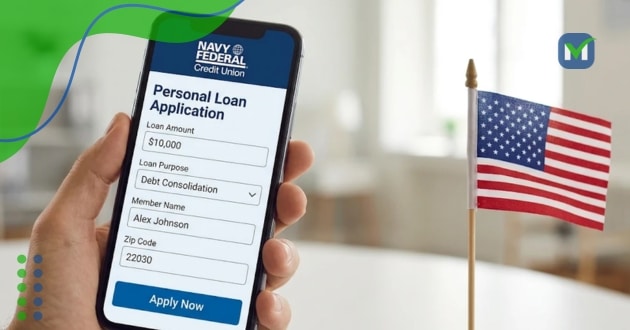
Submitting an application can be done through the official website or directly via the credit union’s mobile app in just a few minutes.
Follow these steps to submit your request:
- Log into your member account using the official app or Navy Federal website.
- Select the personal loans option and set the exact amount you need.
- Choose the ideal term to ensure monthly payments fit comfortably into your budget.
- Fill in your employment information and prove your income using bank statements or pay stubs.
- Carefully review the contract terms and submit your application.
The institution typically checks credit profiles from TransUnion using the FICO 9 scoring model. Keeping your accounts current and maintaining a solid deposit relationship with the credit union greatly improves your final approval odds.
Conclusion (Navy Federal personal loan)
Applying for a Navy Federal personal loan is one of the best borrowing choices for those who meet defense community eligibility criteria.
Clear terms, absence of hidden fees, and a legally mandated interest rate cap make for a much safer borrowing environment than conventional banks.
If you are eligible, evaluate your budget carefully and determine how much you need to borrow.
Do the math, compare available repayment terms, and use credit strategically to reach your financial goals with total peace of mind.